The product bet behind Swoleby.ai is simple: most people do not need another fitness dashboard.
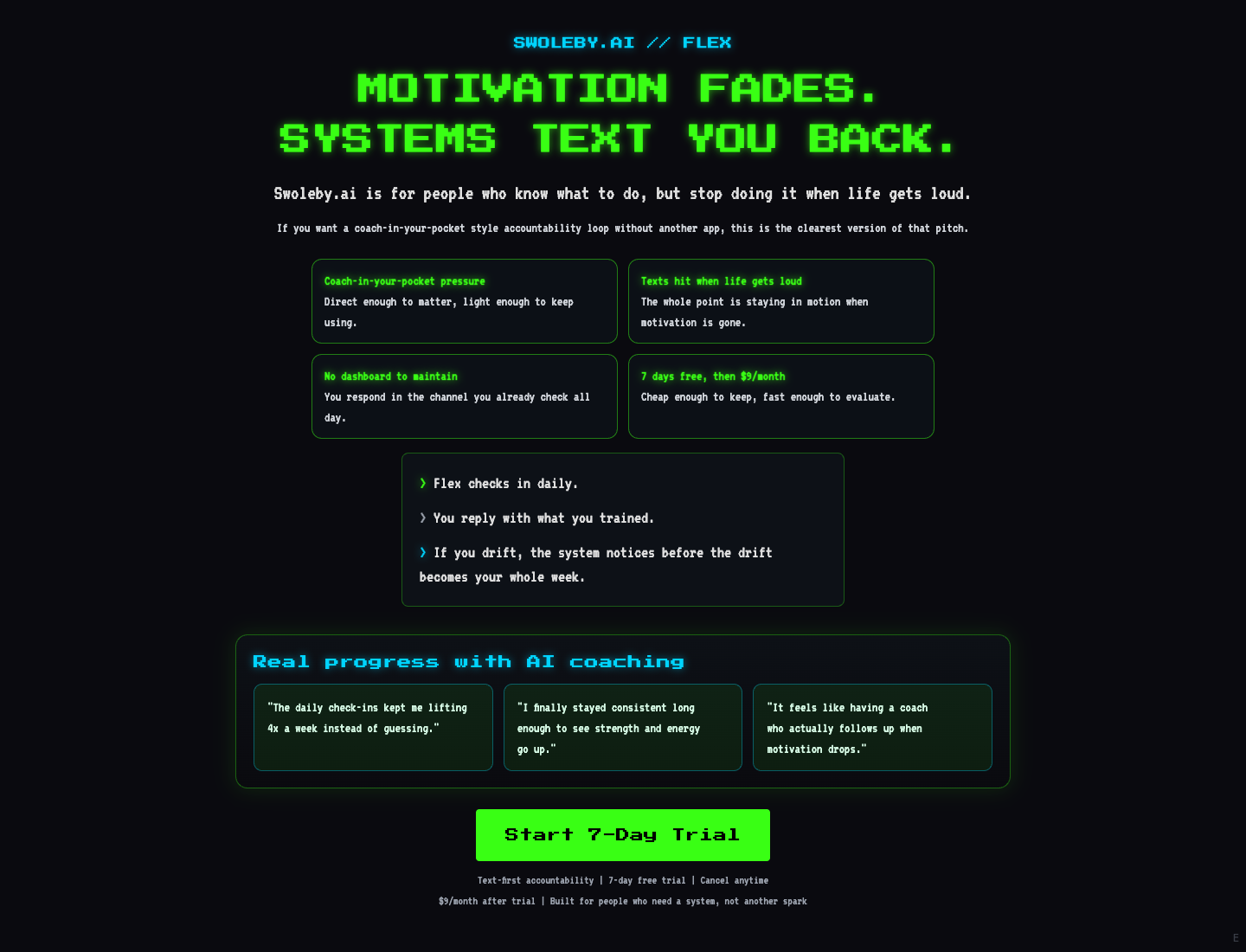
The public site presents the same thesis as the product: motivation fades, systems text you back. That line matters because the marketing page is not separate from the product surface. It is a promise about the loop Swoleby has to deliver once someone enters a phone number and starts the trial.
They need help closer to the moment where behavior happens.
That moment is often small and unglamorous. You are about to skip the workout. You are tired. You feel behind. You do not want to open an app, inspect a plan, update a dashboard, and make a perfect decision. You need a realistic next action.
That is why Swoleby starts with SMS.
SMS is not a limitation in this context. It is the interface that shows up where the behavior happens. It is lightweight, familiar, immediate, and easy to reply to. A good SMS coach can turn a vague intention into a smaller action: walk for ten minutes, do the first set, move the workout, eat something sane, stop making the day binary.
The hard part is not generating workouts. The hard part is the loop around the conversation.
The system needs onboarding, user state, preferences, reminders, memory, opt-outs, subscriptions, dashboard auth, and a way to evaluate whether the coaching is useful. It needs to be direct without being harsh, personal without being creepy, and persistent without becoming notification spam.
That creates interesting AI product questions:
- What should be deterministic workflow logic?
- What should be model judgment?
- How much memory is useful?
- When should the coach ask a question instead of giving advice?
- How should reminders adapt without feeling manipulative?
- What does “good” mean when the outcome is behavior, not a benchmark score?
The SMS surface makes those questions unavoidable. There is no room for decorative product theater. The response has to earn its place in the thread.
The same agent-led development loop I use elsewhere helps automate the product and marketing work around Swoleby. Agents can draft landing-page variants, adjust copy for different positioning bets, wire the signup flow, check that the SMS promise still matches the implementation, and generate eval cases for the coaching responses. That means the work can move quickly without becoming random: product copy, prompts, tests, and behavior checks all point at the same loop.
That is one reason Swoleby is a useful public build for me. It forces applied AI work into a real product shape: user context, safety boundaries, reminders, evals, and the messy gap between what an AI can say and what a person will actually do.
Dashboards are still useful. They can show history, settings, billing, profile state, and progress. But for behavior change, the dashboard should support the loop. It should not be the loop.
The product is the timely nudge, the remembered context, the smaller next action, and the feeling that the system is helping you recover instead of judging you.
Related build notes: Swoleby project, agent-led development control planes, and behavior-based agent evals.